Embodied AI usually focuses on intelligence expressed through an agent with a body. The body may be a robot, simulated agent, wearable system, or other entity that perceives and acts within an environment.
Physical AI is often used as the broader engineering frame. It includes embodied agents, but also emphasizes the complete stack required to operate in the physical world: sensing, dynamics, interaction, control, safety, data infrastructure, and deployment.
Where the terms overlap
Both fields address the observation-action loop. A system perceives its environment, represents relevant state, chooses an action, and receives a changed physical world in return. Robotics, autonomous systems, dexterous manipulation, and human-machine interaction sit comfortably inside both conversations.
In practice, researchers and companies may use the labels interchangeably. The project definition matters more than the label.
A useful working distinction
Embodied AI is a strong description when the central question is how intelligence arises through an agent's body, perspective, and interaction. Physical AI is useful when the central question extends across the operational system that makes physical intelligence trainable and deployable.
- Embodied AI: agent, body, perception, action, and interaction.
- Physical AI: embodied intelligence plus sensing systems, physical constraints, data operations, validation, and deployment infrastructure.
The shared data problem
Internet data can describe physical tasks, but it rarely preserves the full causal structure of an interaction. A model needs to know what was visible, how the actor moved, which action occurred, what changed, and whether the task succeeded.
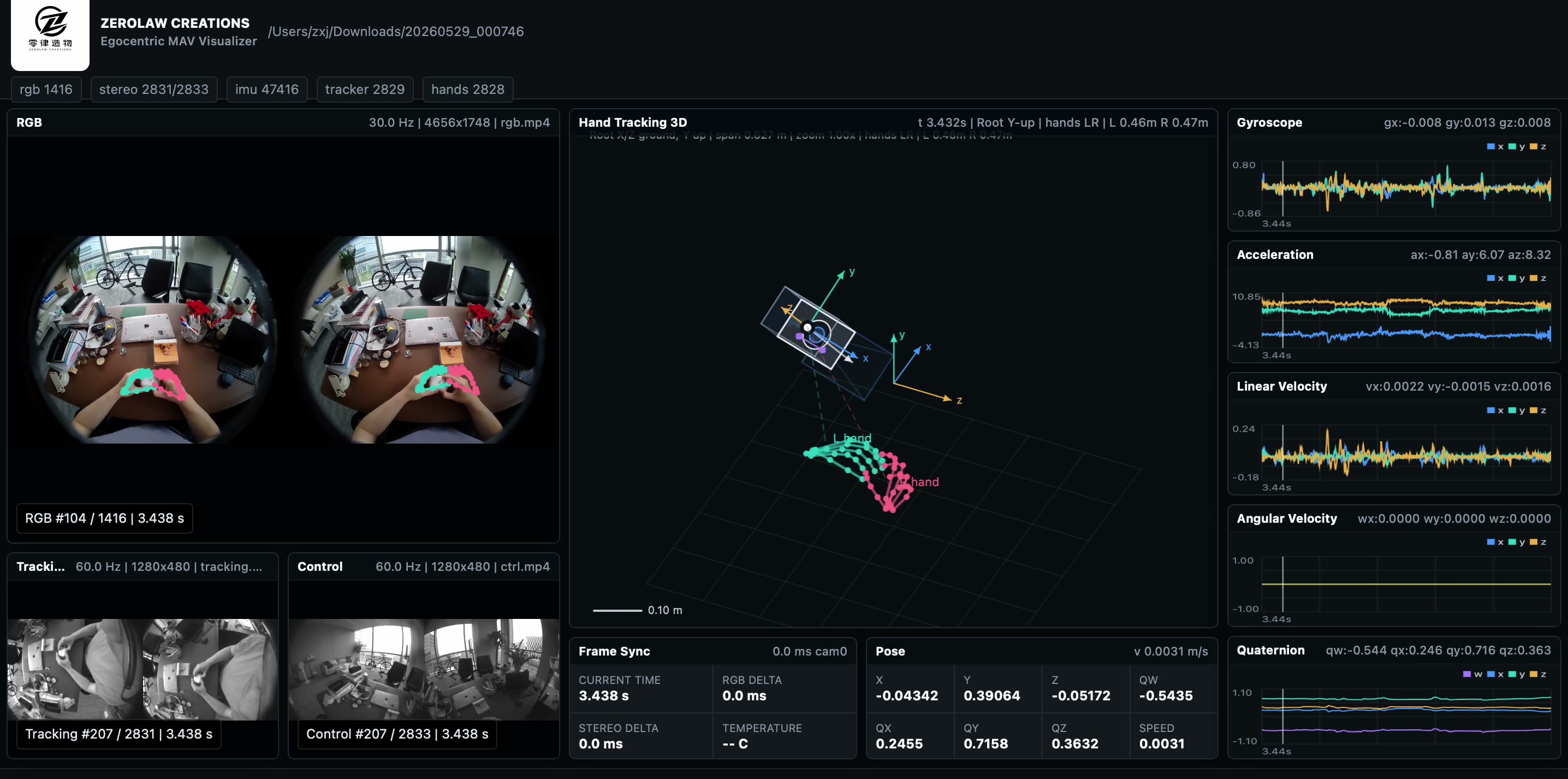
This is why Physical AI data is organized around synchronized episodes rather than footage alone. Vision, pose, inertial motion, geometry, task state, action, and outcome must remain connected on a usable timeline.
Why first-person data matters
Ego data records from the actor's point of view. It preserves what was observable at the moment of action, including real occlusion and attention constraints. For human demonstrations, that viewpoint can connect expert perception to motion and outcome while remaining portable across real workplaces.
Choose the data around the task
A terminology debate does not determine the right dataset. The target skill does. A collection program should begin with the model, task, failure modes, and evaluation criteria, then work backward to the episode schema, sensors, protocol, and quality gates.
That approach applies whether a team calls its system embodied AI, Physical AI, robotics, or an autonomous agent. The data still has to preserve the physical relationships the model is expected to learn.
Zerolaw implements that path through ZL Capture hardware, ZL Core processing and synchronization, ZL Annotation quality workflows, and ZL Corpus delivery. For programs that require EEG, sEMG, custom pose, or other synchronized signals, Zerolaw Multimodal Solutions extends the capture system around the training requirement.