What the expert sees
First-person RGB, stereo, or depth observations at the point of action.
 Zerolaw
Human demonstration data
Record portable, task-grounded demonstrations that preserve what people see, how they move, what they do, and whether the task succeeds.
Definition
Human demonstration data is a structured record of people performing tasks, aligned for models to learn from expert behavior.
The record can connect first-person observations to motion, actions, objects, task phases, and outcomes. It turns tacit know-how into reusable training examples instead of isolated video clips.
Inside a demonstration
A useful demonstration shows both behavior and the conditions under which that behavior was chosen.
First-person RGB, stereo, or depth observations at the point of action.
Head, hand, object pose, and inertial signals on a shared timeline.
Instructions, phases, constraints, environmental context, and object state.
Completion, corrections, failure modes, recovery behavior, and quality labels.
Demonstration workflow
Break the target behavior into tasks, phases, variations, and success conditions.
Select wearable signals that preserve useful context without disrupting the work.
Run a repeatable field protocol across operators, environments, objects, and outcomes.
Synchronize, calibrate, segment, annotate, and package demonstrations for training.
Zerolaw delivery stack
Zerolaw combines field hardware, processing, human review, and corpus delivery instead of handing model teams disconnected recordings.
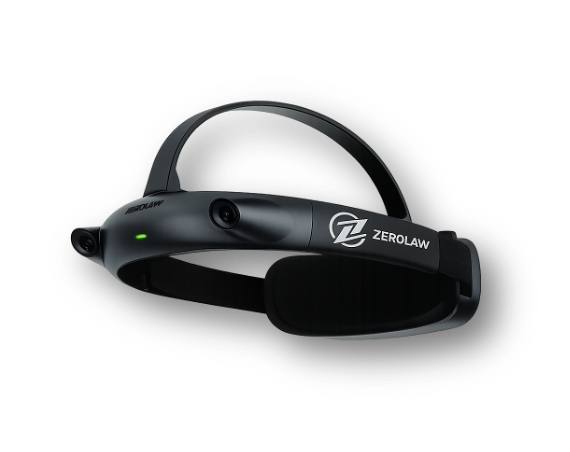
V1 and L1 wearable systems record first-person vision, inertial motion, pose, and depth for different data-density targets.
Cleans, slices, synchronizes, calibrates, and fuses every demonstration into a consistent episode.
Adds task phases, actions, objects, outcomes, and human-reviewed quality feedback.
Packages reusable demonstration datasets, schemas, splits, and provenance for model development.
Programs that require EEG, sEMG, custom pose, or specialized synchronization connect to Zerolaw Multimodal Solutions.
Program choices
| Collection format | Strength | Best fit |
|---|---|---|
| Wearable first-person | Portable and close to the expert's real observation-action loop | Field work, daily tasks, mobile operation |
| First-person + external cameras | Adds independent geometry and interaction context | Dexterous manipulation and benchmarking |
| Vision + pose or IMU | Connects appearance to measurable movement | Skill segmentation and motion-conditioned learning |
| Vision + biosignals | Adds neuromuscular or neural intent signals | HCI, prosthetics, rehabilitation, and BCI research |
Learning applications
Teach policies from aligned examples of expert observation and action.
Adapt general models to domain-specific tasks, tools, and environments.
Learn task dynamics and object change from continuous human interaction.
Compare behavior against expert trajectories, corrections, and outcomes.
Human demonstration FAQ
It is a structured record of people performing tasks, with observations, motion, actions, context, and outcomes aligned for model training.
Imitation learning uses demonstrations as examples of how an expert maps observations and task context to actions. Strong alignment and coverage make those examples more useful.
First-person capture preserves what the demonstrator could see while acting and can be deployed in real workplaces without surrounding every task with external cameras.
RGB or stereo video, IMU, head and hand pose, object state, depth, task instructions, phase labels, success conditions, and human-reviewed semantics.
ZL Capture